
Message preached Sunday, October 5, 2014 from Mark 1:40-45
Theme: When we have truly experienced the life-transforming grace of Jesus, we can’t help but proclaim it.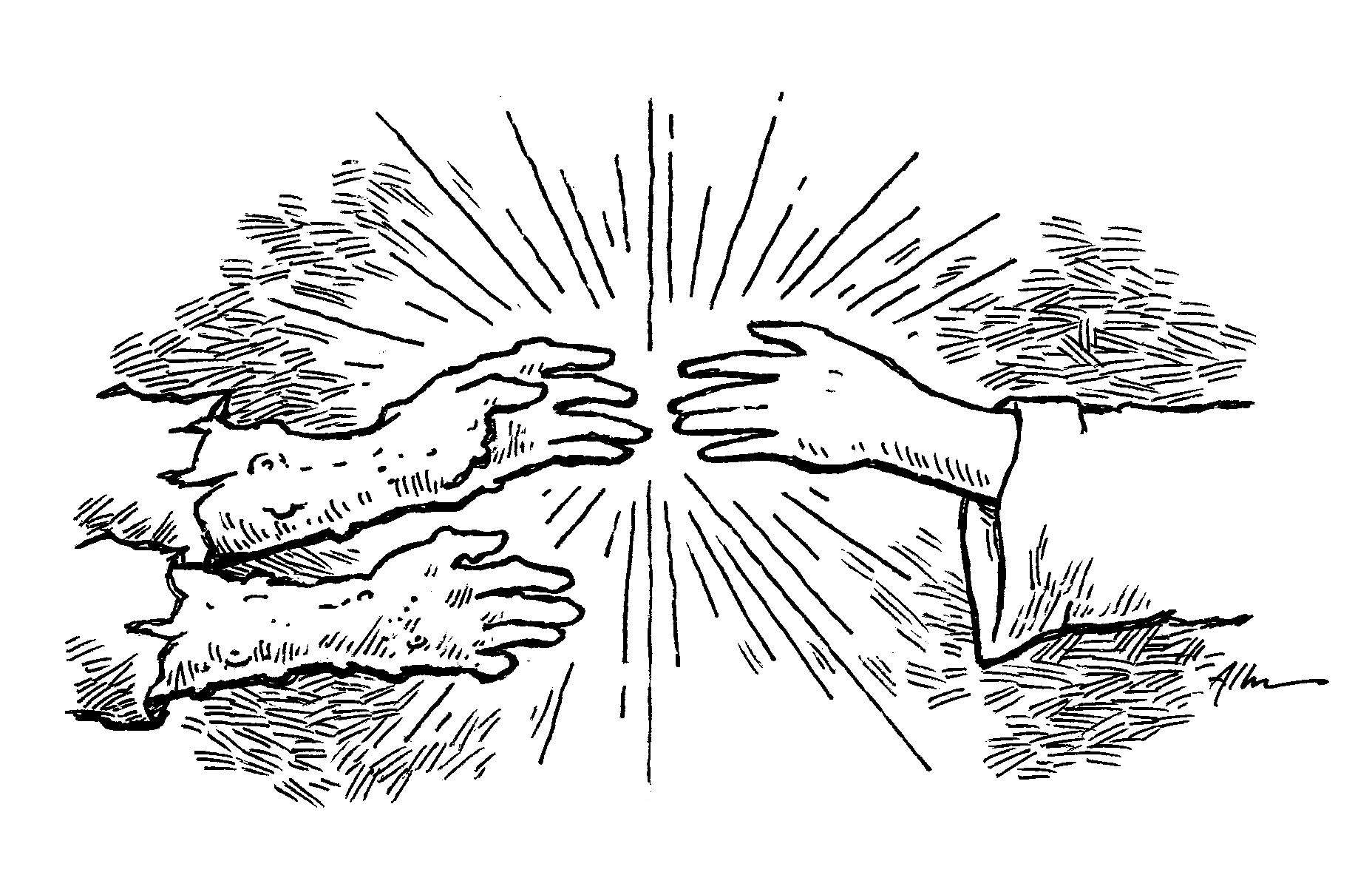
(Unless otherwise noted, all Scripture references are taken from The Holy Bible, New King James Version; copyright 1982, Thomas Nelson, Inc.)
This morning, we come to a remarkable story in the Gospel of Mark. It tells us of something that appears to have occurred during Jesus’ travels early in His ministry. He had begun to go out with His disciples to preach in the synagogues throughout the regions of Galilee. And in the course of His preaching tour, He was met by a very poor and very wretched man in need. The man was a leper. We’re told of how Jesus had been healing people with all kinds of illnesses, and was casting out demons. But a leper was a pretty remarkable case. Those who suffered from leprosy in those days were in one of the most pathetic situations of human suffering you can imagine. The leprosy of Bible times may be very much like what we today call Hansen’s disease—a dreaded chronic infection that shows itself in hideous scaly blotches and scabs, and that results in extreme weakness of the body. In some cases, it was a horribly disfiguring disease; because it resulted in a deadening of portions of the nervous system. Hands and feet, and fingers and toes, and even noses and ears became rubbed off and lost because the leper couldn’t feel pain and didn’t know they were being repeatedly injured. No one dared to have contact with a leper. They were the true “untouchables” of society. In popular culture today, and in a lot of really cheesy movies, people make a lot out of “zombies”. Well; in ancient times, a group of helpless lepers staggering into town might have been viewed with almost the same kind of horror as group of zombies coming into town would be viewed today. They were considered ‘the living dead’. Those who suffered from leprosy were forcefully ostracized from society—even from family and friends. They were not permitted to come into a walled city or town; and if they attempted to do so, out of desperate need for food or care, rocks would be thrown at them to drive them away. Wherever they went shuffling slowly and painfully along, they were required to cover their faces with a cloth or with their mouth, and to warn people who might come near them by crying out, “Unclean! Unclean!” They were in a perpetual state of misery—incurable, hopeless, utterly at the mercy of other people to pity them and leave something for their daily needs. And as Jesus traveled and preached, one of them came to Him. Jesus was the right Person to come to. He who healed all other diseases and cast out demons was also certainly able to make this man well. But as it turned out, doing so led to problems of another kind. Mark tells us;Now a leper came to Him, imploring Him, kneeling down to Him and saying to Him, “If You are willing, You can make me clean.” Then Jesus, moved with compassion, stretched out His hand and touched him, and said to him, “I am willing; be cleansed.” As soon as He had spoken, immediately the leprosy left him, and he was cleansed. And He strictly warned him and sent him away at once, and said to him, “See that you say nothing to anyone; but go your way, show yourself to the priest, and offer for your cleansing those things which Moses commanded, as a testimony to them.” However, he went out and began to proclaim it freely, and to spread the matter, so that Jesus could no longer openly enter the city, but was outside in deserted places; and they came to Him from every direction (Mark 1:40-45).* * * * * * * * * * Now; there’s no way around it. This leprous man disobeyed the Lord who had healed him. Some Bible teachers have characterized him very negatively because of this. But personally, I find it very hard to blame him. Whenever I read this leper’s story, I always think of my own. I was never a literal leper, of course; but I was a very great sinner. And leprosy, in the Bible, is presented to us as an illustration of the desperate situation sin puts us in before God. The disease of leprosy has a lot in common with our fallenness in sin. For one thing, they are both ‘deep-seated’ afflictions. People often think of leprosy as merely a skin disease; but in reality, it was a disease that permeated the entire body—inside and out, and down the the deepest level. And that is certainly true of sin. We fell into sin with our father Adam. And now, our condition of sinfulness before God permeates every aspect of our being—so that we are not able to do anything before God that does not somehow involve the taint of sin. In Reformed theology, this is referred to as ‘Total Depravity’; and it’s not the idea that everything we do is utterly depraved, but rather that everything we do—even the best of things that we can do—bears the contamination of sin. Both conditions also put us in a state of loathsomeness. The disease of leprosy made someone utterly repulsive, so that they could not be allowed to enter into the social world of normal humanity; nor were they allowed to go into the temple and appear before God. They had to walk around in shame as outcasts. And that’s also what sin does to us. Our sin makes it so that we cannot enter into fellowship with a holy God. Not even our best works of outward righteousness and religion—done from the standpoint of our fallenness in sin and apart from His redeeming grace—can make us acceptable in His sight. And just as the condition of leprosy was humanly incurable, so is our fallenness before God. We can not rid ourselves of our own sin—no matter how hard we may try. All we can do is cry out to God and say, “Be merciful to me, the sinner!” Well; that’s what I was. I was a rebellious sinner before God. I was a spiritual leper before Him. Every time I even thought of Him, my heart convicted me and cried out against me, “Unclean! Unclean!” I was doomed before a holy God, and was destined for eternal judgment—without hope. But in the summer of 1973, I heard the good news that Jesus had died on the cross to take the guilt of my sin away from me, and to make me clean. I put my trust in Jesus, prayed for the forgiveness of my sins, and He washed every stain away. I immediately felt all of the guilt and shame of my sin taken from me, and I finally felt clean inside before Him. And very much like the leper that Jesus cleansed, do you know what I did almost immediately? I didn’t know you were supposed to do this, but I did it anyway—just as a natural impulse of my heart. I called my best friend up on the phone the very next morning, and told him, “Do you know what happened to me last night? I got ‘justified’! I prayed with Billy Graham on television, and asked Jesus to wash my sins away; and He did! And now I’m ‘justified’—’just-as-if-I’d never sinned at all’!” I’m sure my friend was looking puzzled at the phone as I told him this. In fact, I began to tell my other friends too. I got into a lot of trouble with them over it. I lost a few of my friends, and even suffered a few things from them because of my faith. I drove my family crazy, and seriously worried my parents. I have to be honest; when it came to proclaiming what Jesus did for me, I don’t think I did it right most of the time. I don’t think the leper did either. But like him, I couldn’t help talking about the transformation Jesus had made in my life. I didn’t know whether you should tell other people about it or not, and I certainly didn’t understand how I was supposed to go about it. But I did it anyway. So; I guess I’ll always think of this leper as my friend. I can identify with him in the way that he told everyone about what Jesus did for him—as wrong as he may have been in the way he went about it. And I think that this is the great lesson to be learned from this morning’s passage. When we have truly experienced the life-transforming grace of Jesus Christ, we can’t help but proclaim to others what He did for us. Lepers who are cleansed by Jesus just can’t keep quiet about Him! * * * * * * * * * * Let’s look at the story in a little more detail. Consider first . . . 1. THE LEPER’S REQUEST. Mark tells us, “Now a leper came to Him, imploring Him, kneeling down to Him and saying to Him, ‘If You are willing, You can make me clean’” (v. 40). I love it that this man took the initiative to approach Jesus. It was a very daring thing to do; because it would be ceremonially unclean for any Jewish person to have contact with a leper; and Jesus was manifestly a holy Jewish man. I suspect that the news that had begun to spread about Jesus—the story of how He cast the demon out of the man in the synagogue, and of how He had healed the multitudes that had gathered around Him in Capernaum—had reached the ears of this leper. I wonder if, when He heard that Jesus was coming nearby to preach, he realized that Jesus could heal him. But would He do it? Would He show such mercy to an untouchable such as him? And so he came—not to demand anything of Jesus, but just to humbly affirm that Jesus could do it . . . if He only would. I found a great insight recently from an old preacher from a few generations back—Dr. William Graham Scroggie. He suggested that this poor leper’s prayer to the Lord was worthy of careful attention; and what Dr. Scroggie said about it could almost have been a sermon itself! He said that the man’s prayer to Jesus was . . .
- Expectant, because the man came.
- Reverent, because he knelt.
- Personal, because he had no one but himself in mind.
- Earnest, because he implored.
- Definite, because he asked specifically for cleansing.
- Submissive, because he said, “If You are willing . . .”
- Confident, because he said, “You can . . .”
- Brief, because it took only five words in the original Greek to say it.
- Effectual, because he was cleansed.
W. Graham Scroggie, The Gospel of Mark (Grand Rapids: Zondervan Publishing House, 1976), pp. 44-45).